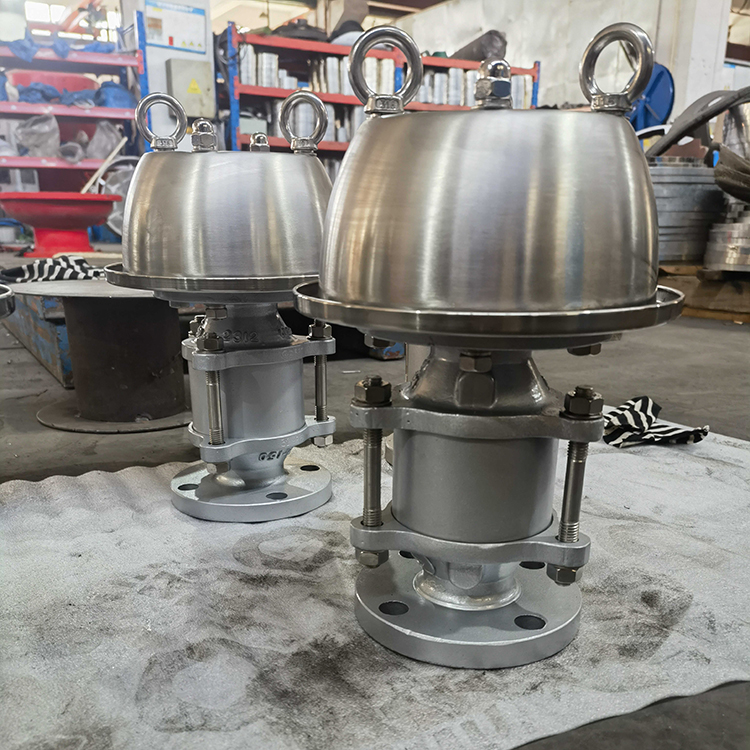
Producdt Description:
The ZCZGB-III End-Of-Line Flame Arrester is a high-performance safety solution engineered specifically for atmospheric storage tank vents. Unlike in-line models, the ZCZGB-III is built to withstand extreme environmental exposure. A central feature of this Flame Arrester is its rugged stainless steel rain cap, which deflects both vertical and wind-driven precipitation. By ensuring that moisture does not accumulate on the internal quenching matrix, the rain cap maintains the operational integrity of the device in all weather conditions.
High-Efficiency Flame Elements & Quenching Technology
The core fire suppression capability of the ZCZGB-III lies in its precision-engineered flame elements, which serve as a critical thermal barrier for your storage tank.
-
Advanced Heat Dissipation: This Flame Arrester is equipped with precision-wound corrugated filter elements or multilayer metal mesh flame elements.
-
Subsonic Deflagration Quenching: These flame elements extinguish subsonic deflagration flames by rapidly dissipating heat, cooling the combustion front before it can penetrate the tank.
-
Atmospheric Protection: Optimized for “end-of-line” applications, the internal flame elements provide a reliable defense against fire risks originating from the surrounding atmosphere.
Installation:
- Remove all flange cover and discard all packaging materials.
- Check the seat, the matching flange gasket on the seat surface. It must be clean, flat, scratch-free, corrosion-resistant, tool traces.
- Check the gasket to ensure that the material is suitable forapplication.
- Lubricate all studs and nuts with proper thread lubricant. If the fastener is a high temperature stainless steel material, a back-grabbing compound, such as molybdenum disulfide, is used.
- Inside gasket of bolt ring.
- Installing flange of Inline flame arrester shell to butt with flange of pipeline, attention should be paid to the position of lifting handle and top nut of In line flame arrester element to facilitate the removal of In line flame arrester elements in the future.
Note:
Under normal circumstances, (fire) breathing valve operating pressure to B shall prevail;
Applicable materials: gasoline, kerosene, diesel, aromatics, sulfur, air and other petrochemical materials;
Environment temperature: -40 °C -+60 °C;
Shell material: HT, AL, A3, 18-8, 304, 304L, 316, 316L.
Flange standards: HG20592-97 PN1.0 (also can be produced according to user specified criteria)“Protect Your Vent Stacks from External Fire Risks. Request a Technical Specification Sheet for the ZCZGB-III Today.”
Choosing Between In-Line and End-of-Line Flame Arresters
Q1: Why is a rain cap necessary for an end-of-line flame arrester?
A1: The rain cap protects the sensitive internal flame elements from rain, snow, and debris, which could otherwise clog the quenching matrix and prevent the tank from breathing safely.
Q2: Can the ZCZGB-III be installed in a closed piping system?
A2: No. This model is specifically an “end-of-line” unit designed for venting to the atmosphere. For closed-loop piping, you must use an in-line flame arrester like the ZCZHQ-II.
Q3: Does the rain cap affect the flow rate?
A3: Our engineers have optimized the rain cap design to provide a high-discharge area, ensuring minimal pressure drop while maintaining full environmental protection.
Q4: Is this model suitable for hydrogen (Group IIC) applications?
A4: While standard units cover IIA/IIB3, we can customize the flame element matrix with smaller gap sizes specifically for hydrogen or other high-volatility Group IIC gases.
Q5: How often should I inspect the internal flame element?
A5: We recommend a semi-annual visual inspection. The ZCZGB-III is designed for easy disassembly, allowing you to quickly clean or replace the flame elements to ensure peak safety performance.